We use coin flips as the almost universal example of randomness.
Heads or tails. 50/50.
Need to make a decision? Flip a coin.
Need to explain probability to a kid? Flip a coin.
Need a source of randomness? Well… flip a coin.
Except I’ve been thinking about this lately:
Is a coin flip actually random?
Imagine the perfect coin-flipping machine
Forget a human hand for a moment.
Imagine I build a machine that can hold a coin in exactly the same orientation every time.
It launches the coin with exactly the same:
- force
- angle
- rotational velocity
- position
And it does this in a vacuum, onto an identical surface, from the exact same height.
Would I really expect a different result every time?
Probably not.
I’d expect the coin to do exactly the same thing.
If it starts heads-up, rotates 17.5 times and lands tails, then repeating precisely the same physical conditions should give me tails again.
And again.
And again.
There’s nothing obviously random happening here.
It’s just physics.
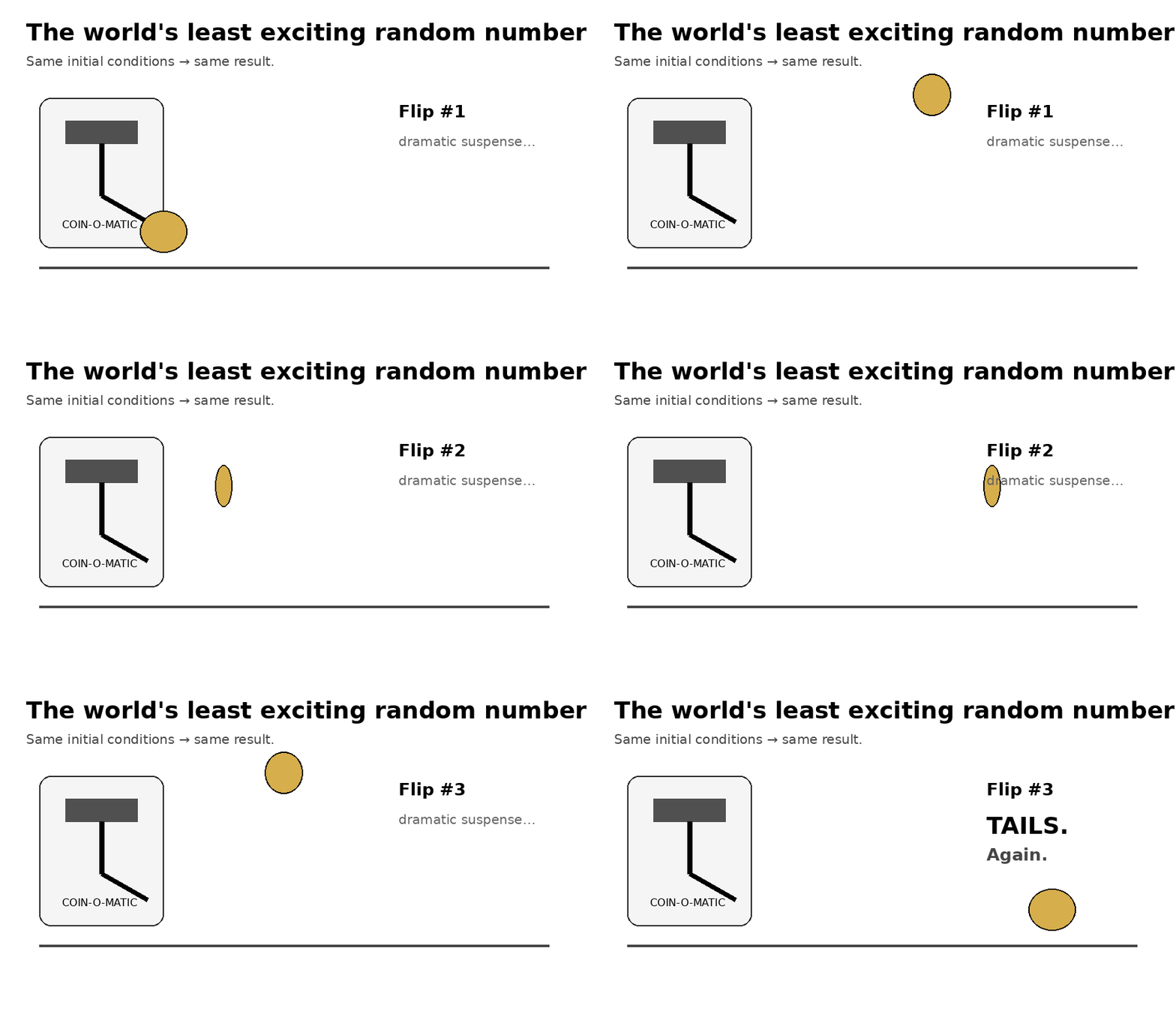
So why can’t I predict a normal coin toss?
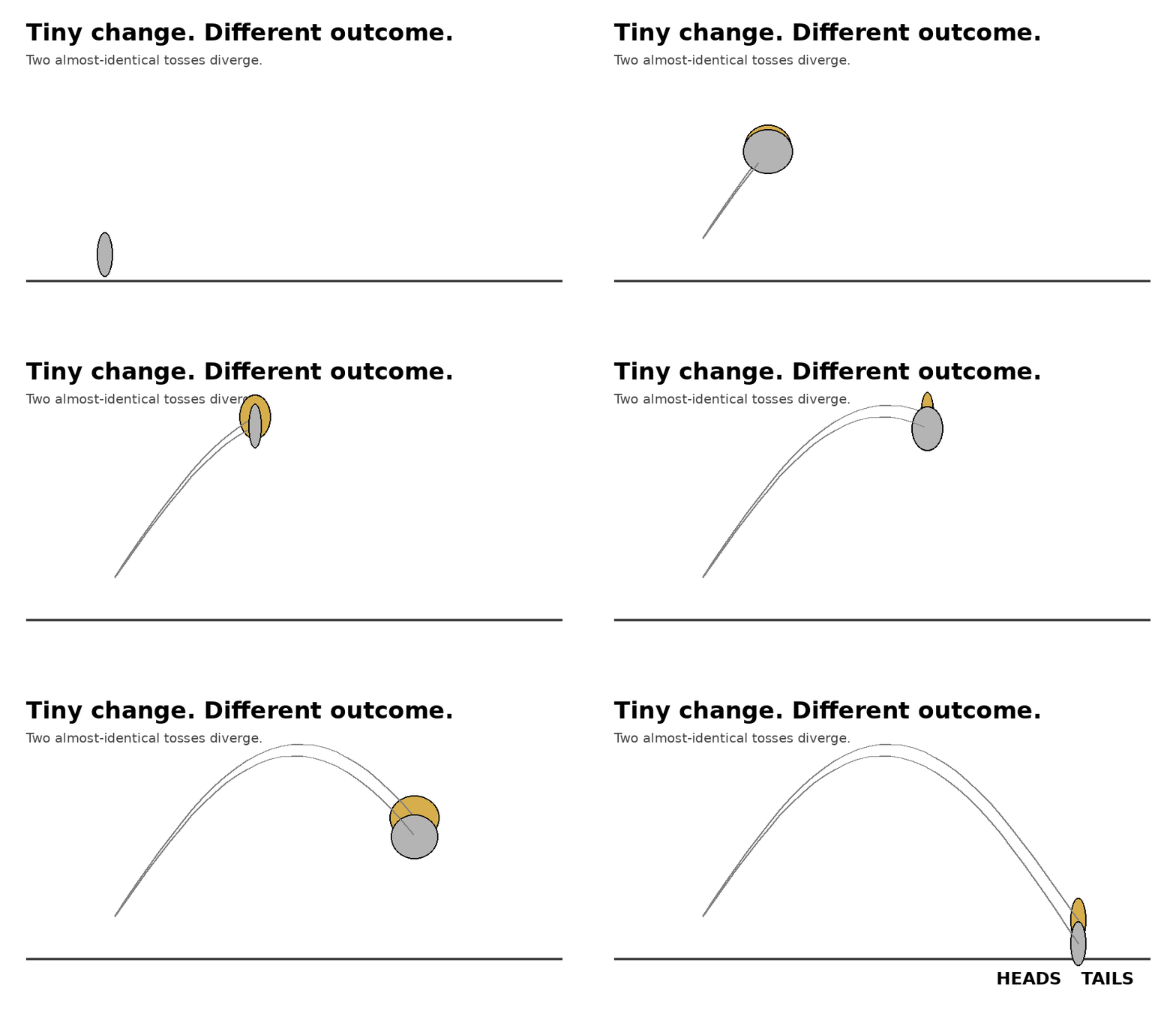
Because a human coin toss is ridiculously sensitive to its initial conditions.
A tiny difference in thumb pressure changes the rotational speed.
A tiny change in launch angle changes its trajectory.
Air moves around it.
The coin hits your hand slightly differently.
Or it hits a table, bounces, rotates again and eventually settles.
All of these tiny differences compound.
So although the system may be deterministic, it’s effectively impossible for us to know its starting conditions accurately enough to predict the result.
This is basically chaos.
And that’s an important distinction.
Unpredictable does not necessarily mean random.
Randomness versus ignorance
Suppose I put a coin under one of two cups while you’re not looking.
I know which cup it’s under.
You don’t.
From your perspective:
P(left)  = 0.5
P(right) = 0.5
But nothing random necessarily happened.
The coin is already sitting under one particular cup.
The probability represents your lack of information.
A coin toss might be similar.
The moment the coin leaves my thumb, perhaps the outcome is already completely determined by its position, velocity, angular momentum, air resistance, gravity and everything else interacting with it.
I simply don’t know those values accurately enough to calculate the answer.
So I describe the result probabilistically:
P(heads) ≈ 0.5
P(tails) ≈ 0.5
That’s an extremely useful model.
But it’s not necessarily a statement about the fundamental nature of reality.
And 50/50 is another assumption
There’s actually a second assumption buried inside the usual coin-flip example.
Not only do we assume it is random.
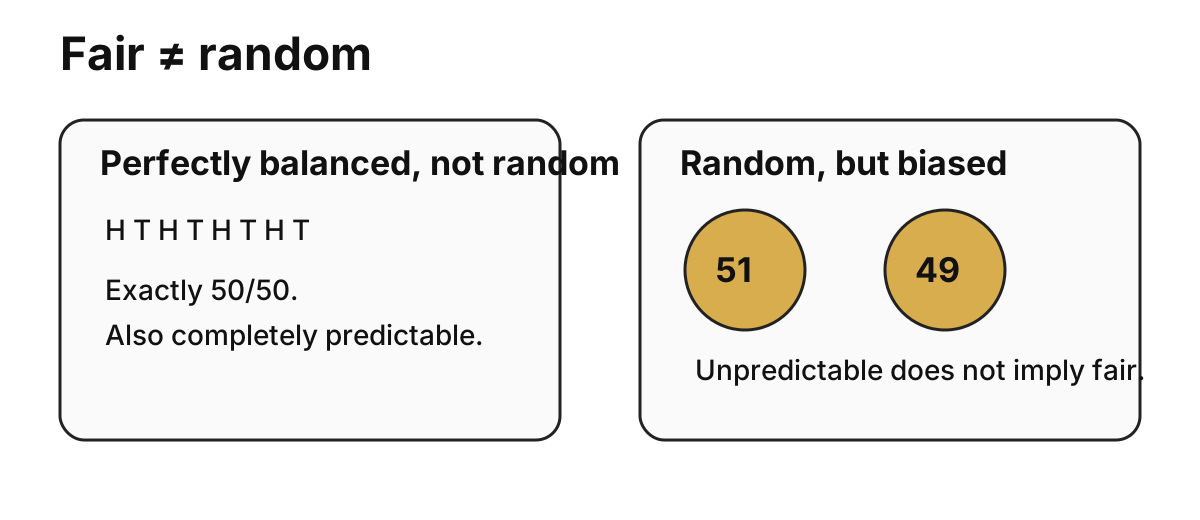
We assume it is fair.
Those aren’t the same thing.
A coin might have:
- slightly uneven mass distribution
- different geometry on each face
- a preference for its initial orientation
- a particular flipping technique that introduces bias
You could have something that is extremely difficult to predict while still producing heads 51% of the time.
Likewise, you could have a completely deterministic machine deliberately designed to alternate:
heads
tails
heads
tails
heads
tails
After a million flips its distribution would be almost perfectly 50/50.
But there would be absolutely nothing random about it.
So:
fair ≠ random
and
unpredictable ≠ random
Those distinctions are easy to forget.
Could we predict a coin toss?
In principle, yes.
If I could measure the coin’s initial state accurately enough and had a sufficiently good model of the environment, classical mechanics should let me calculate how it lands.
The interesting thing is that you wouldn’t necessarily need absurd science-fiction precision either.
If you tightly control the flipping mechanism, coin tossing becomes much more predictable.
Which means our everyday “random number generator” is really relying on something else:
our inability to precisely reproduce and measure the physical conditions of the toss.
That’s actually a pretty clever source of practical randomness.
Shake a complicated physical system enough that measuring its state becomes impractical.
Then sample the result.
But then quantum mechanics enters the room
This is where the question gets much more interesting.
Classical physics allows this picture of the universe:
initial state
      ↓
laws of physics
      ↓
future state
If you knew the initial state perfectly, you could theoretically calculate what happens next.
But quantum mechanics appears to behave differently.
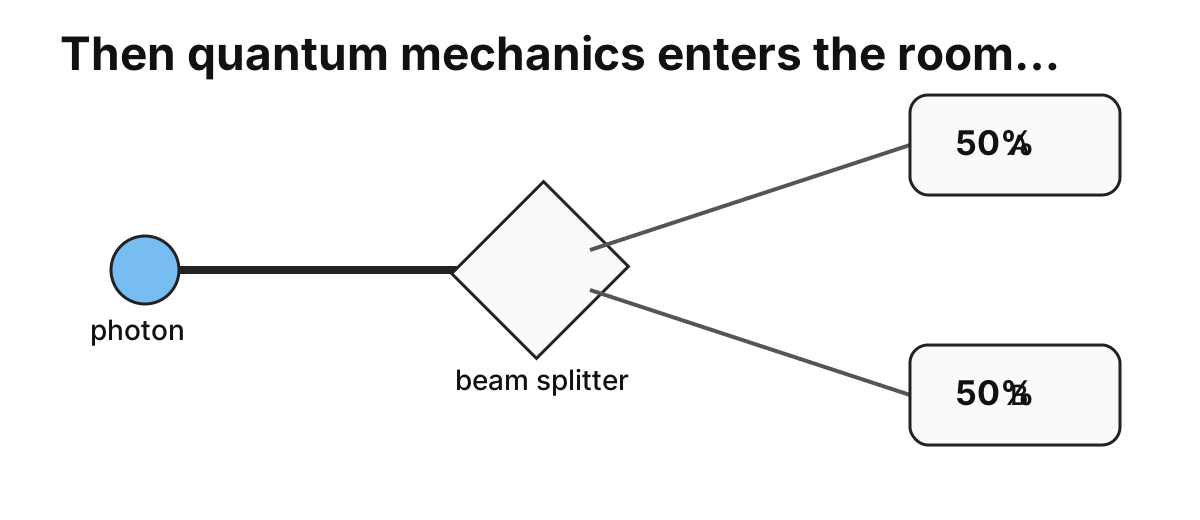
Imagine firing a single photon at an apparatus where quantum mechanics says it has a 50% probability of being detected in one place and a 50% probability of being detected somewhere else.
Quantum mechanics doesn’t merely say:
“The photon already chose and we just don’t know the answer.”
At least in the standard formulation, the theory says the measurement itself has genuinely probabilistic outcomes.
That’s a much stronger claim.
The randomness isn’t merely caused by my inability to measure the system.
It appears to be built into the physics.
And experiments around Bell’s theorem have made the simplest version of the alternative explanation — that particles merely carry hidden predetermined local answers — extremely difficult to maintain.
There are still interpretations of quantum mechanics where reality underneath the probabilities is deterministic.
Bohmian mechanics is one example.
But then you have to accept other rather strange consequences, such as nonlocality.
So we’ve gone from:
“Is a coin flip random?”
to:
“Is anything in the universe actually random?”
rather quickly.
A better way to think about the coin
I think the cleanest way of putting it is this:
A coin flip is practically random.
It is:
- difficult to predict
- easy to perform
- approximately unbiased
- extremely sensitive to tiny physical variations
Those properties make it a fantastic randomisation mechanism for humans.
But none of them require the coin itself to be fundamentally random.
The physics governing the coin may be entirely deterministic.
What we’re really exploiting is our ignorance of the system’s exact state.
And I find that distinction fascinating because it changes what the word random means.
Sometimes when we say:
“That was random.”
what we really mean is:
“I don’t have enough information to predict that.”
Those are very different statements.
And somewhere down at the quantum level, nature may contain the genuinely random thing we thought the humble coin was doing all along.